
Interview with Dan Kraines, Author of Strap
American poetry needs a vibe shift

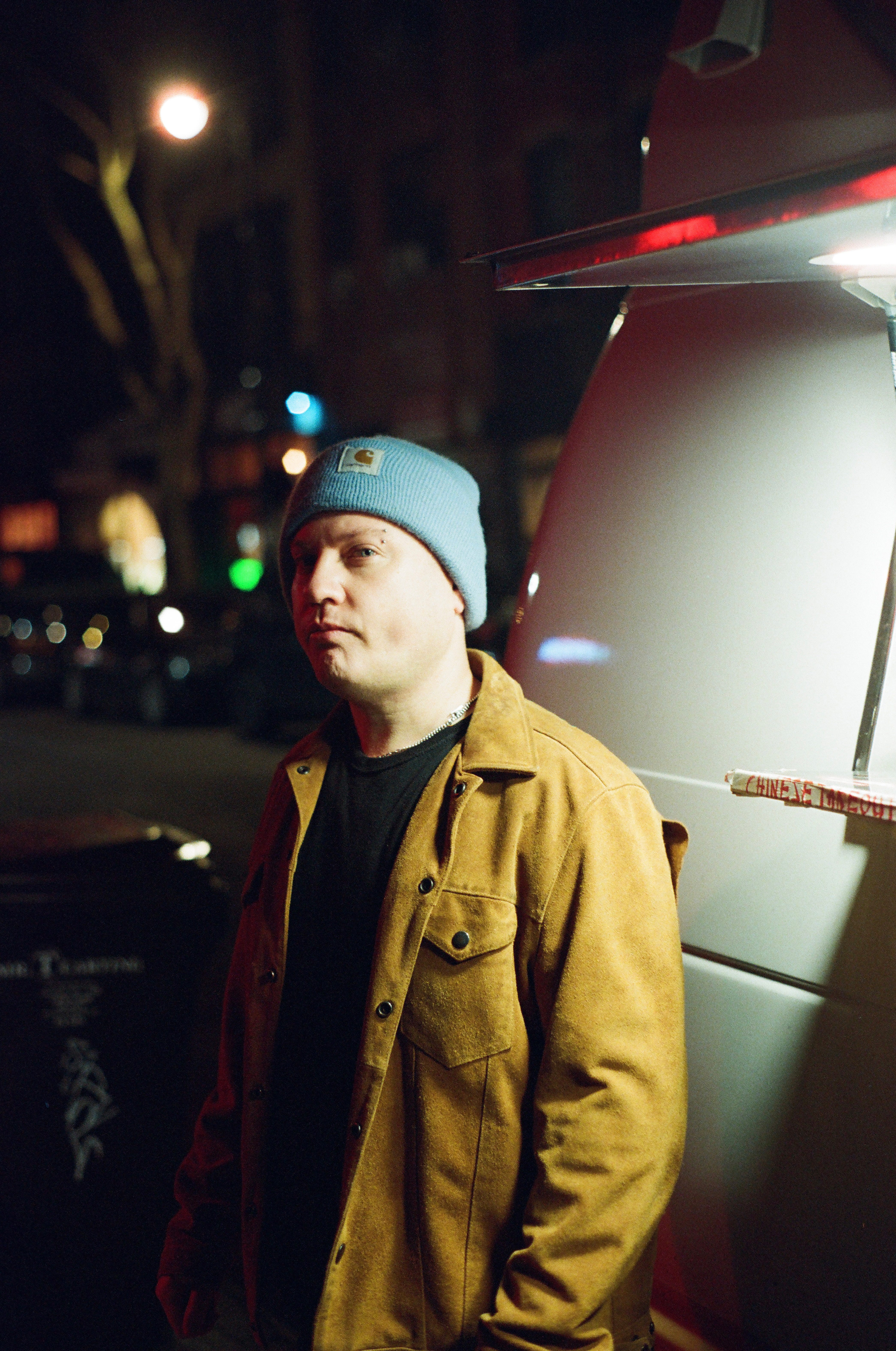
Dan Kraines is a queer poet of Viennese, Bolivian, and Ukrainian heritage. Strap is his first full-length book. He has published two chapbooks: Licht and Jaffa. Dan works at the writers’ residency Hawthornden Brooklyn on weekends and for the poet Sharon Olds during the week. He taught creative writing and creative nonfiction at the Fashion Institute of Technology and ELA at high schools for underserved students prior to his current work. Queer Longing, his PhD dissertation, won the Susan B. Anthony prize for gender and sexuality studies from the University of Rochester. He lives in an old tenement apartment on the Lower East Side.
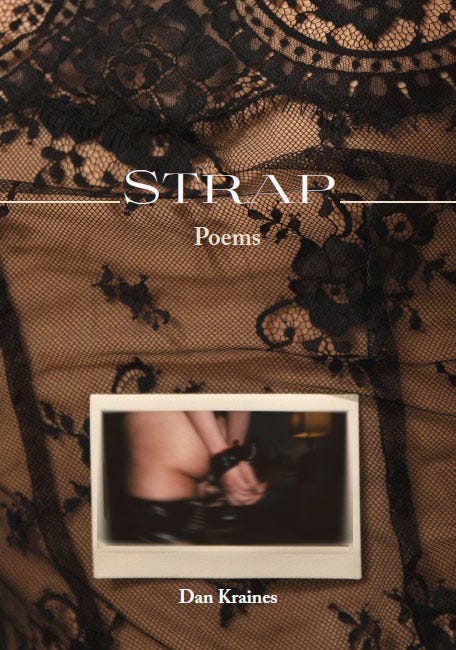
Strap is currently available for preorder. Get a copy here.
Your bio mentions your Viennese, Bolivian, and Ukrainian heritage, as well as your queer identity. How has the intersection between these identities shaped and influenced the way that you write and think about poetry
DK: I live on the Lower East Side. There was someone in my building, a boy, a girl—across generations—who was exactly the person I am. Our social positions change. But we are essentially who I am, who they were, and I’m carrying her forward, I am him today. We have the same spiritual and intellectual drives, emotional makeup, and harness (or lack of connection) to the world. Even as the neighborhood has changed, and the building converted, we move back and forward, unbound, essentially, except to one another.
Writing shapes how I see myself, my histories, unique and shared. And writing shapes how my friends see me. It is my inner self manifest and shaped to the page.
The nation state, that which ethnically cleansed and murdered my family, does not define me any more than the nation state which murders for me. Mountains in which my family found refuge, mountains which we fled, trains on which we escaped, trains which chuffed us to extermination, none of these turns of phrase
fully express who I am. Not Vienna, the Alps, the Andes, Crimea, the Donbas. Not any more than the forged passport or the passport that customs flags upon reentry. I reject the nation state and I understand its necessity. One doesn’t have to be Ronald Reagan here. I’m not Yasser Arafat. Gd bless. Do you think I’m Joan Didion? Golda Meir? I reject—and have always rejected—the origin stories of nation states, the mythos that justify murder, and the intentional incitement of violence.
Compared to the other poems, “Confessional” stood out by its only 3 lines, late in the book. How would you describe the significance of this and how it fits thematically within the collection?
DK: There are other sardonic moments in the book, but I intended “Confessional” to be a dark comment on the book’s mode, rejecting and mocking expectations established by deeply personal writing. Against broad terms such as Zionism, Trauma Narrative, and Confessional poetry, Strap untethers experience from the narratives that bind us and from what we tell ourselves is true. I’m interested in breaking open narratives, in unbinding myself from ideology; finding space for others to connect, in the face of hostility, against the chest of doctrine, wrapped and unwrapped. To expunge the trauma narratives I internalized requires penetration—strap as catharsis, as reinvigoration, as release. And so “Confessional” also reads as such, as confession, as the very problematic and kind of poem I’m mocking.
I like to feel that I’m writing toward a surprise. I like writing poems which are not predetermined and final; I also like writing tragedies, poems that inevitably create pleasure from a wound. This book doesn’t end in a wedding.
With the current climate surrounding Israel and Palestine, how do you feel your book speaks to the current moment? How might readers of different faiths and ethnicities engage with your book?
DK: Anyone who experiences devotion will vibe with Strap. Devotion is pleasure. Devotion can also be catastrophe.
I gave Jaffa, the first sequence of Strap, to a Palestinian writer, living in Paris, who said it made her want to go back to Jaffa. Dreamed futurity is a necessity.
The impulse to return, for a diaspora, grows stronger against denial.
I would love to meet my friend back in Jaffa.
The relentless bombing of Gaza and starvation therein is not a “current climate”
any more than hell is. Do the underground tunnels of Gaza have a current climate? An ecosystem? Is there a “current climate” under the Iron Dome? Of refugee camps? What is the climate of starvation? Of rape? Of a Druze futbol field, bombed? Can a breast sliced 0ff and passed, like a ball, be considered a product of a current climate? What is the current climate of the family forced to watch?
Can we really know what Syrian Druze, who are said to yearn for Israeli protection, rather than Hezbollah, feel (as they’re killed by Syrian militia)? Are polls taken, under a regime, accurate? Is a population’s support for a regime justification for their murder—not under the Geneva Conventions, a provision written after the Allies relentlessly bombed Germans, Germans who supported Hitler. And why aren’t the voices of people against their regime amplified by the American left? Is the left, despite its histories, at long last, against regimes?
What I’m arguing is the difference between an emotional climate and an ecogenocide. If a home cannot have roots, must be washed away, what’s left next door?
The rhythms of devotion, that which puts us under, that which lifts us up, beat for you; for you, here, with Strap, your chance to reject your own regime and fall under it again, if you must. “What are the tyrannies you swallow” Audre Lorde asked, and here, you can spit them into someone’s mouth and swallow a goddess down. You will stay silent; you will find words.
“Dead Sea” was one of many poems from Strap with beautifully crafted lines, specifically with the inclusion of the notable phrase “From the river to the sea.” Can you describe your process or inspiration for writing this poem?
DK: Beautifully crafted lines, thank you! My face doesn’t need minerals of the Dead Sea or Gwyneth Paltrow’s goop!
Lines of “Dead Sea” embody impossibilities of desire, the enticements of it, as well as its entrapments. What you’re grasping is: choking is crucial to liberation and liberation is inextricable from choking. How one reads any poem, especially this one, depends on who one is at that moment. One person’s fear of pogrom is another person’s call to revolution.
The poem “Dead Sea” is a paradoxical expression.
I set two columns up on the page and wrote in lines of three, facing one another.
In your poem, “Golan Heights,” there is a line that reads, “Land that is a tongue/ cut from its root. Dry air fills/ my mouth.” How were you imagining the relationship between language and land (or landscape) while writing these poems? How does language as both a subject and a poetic tool connect to the many geographic landscapes in your poems?
DK: I don’t see language as natural to expressing the displaced persons’ relocation, known today as ‘settler colonialism,’ like Holocaust survivor Elie Wiesel, and I don’t imagine that it can fully express the Nakba, the ethnic cleansing of Palestinians, like Mosab Abu Toha. Even the near syntactical balance of that sentence—trauma equated grammatically—makes me cringe, even if inexorable tragedies occurred conterminously, which they did.
Natalie Diaz’s “The First Water Is the Body,” unpacks my understanding of water and figurative language, as do my own poems at times, of course. My work puts pressure on a distinction between the figurative and literal, “subject and poetic tool,” since language is always representational, and the land of my poems is quite literal, though ‘land’ is inextricable from me, poems an embodiment of myself.
“Land that is a tongue” is a metaphor and the metaphor here keeps in its mouth a longstanding colonial history, land that has been conquered many times over, with archeological sites throughout it, a gunman atop the holy wall, an inherent schism between mundane and eternal time, terror and safety, normalcy and emergency, illegal settlements and refugees.
The Golan Heights are still extremely controversial, annexed by Israel since 1967, won through the Six-Day War, at a time when Egypt occupied Gaza. In the poem I mention the work of a Mossad spy, Eli Cohen, who worked himself into the uppermost echelons of Syrian government, and who planted trees for Syrian soldiers, signaling their station to Israel when they bloomed in June, 1967. The Israeli war planes hit the eucalyptus trees and Syrian soldiers with bombs. Eli Cohen had been hanged publicly; his intimate radio transmissions tapped by the Soviets and Syrians. Stolen identities and wished for borders, strategic messages and vulnerabilities, an ongoing history, two lines in a poem, the Golan Heights. I stood there. “Can you show what bothers you?” the poem asks. What are the consequences of revelation and for who? Once our so-called boundaries have been ruptured, do we see the damage as irreparable, forcing us to reorient, and do we give up on what was once whole in our striving for restoration, in our effort to heal?
The book is structured in a way where each section feels quite separate from the other, and is even divided by photographs. Can you describe your process of how you developed the sections and how you see each interacting with the other?
DK: Any book I love, including I hope, one I write, will make a shape in its unfolding unlike any other book. I love to see a movie, too, that makes a shape I wouldn’t have seen, or anticipated, and I maybe can’t even describe. I love being left with a feeling of deep impact or weird lightness that, at the closing credits, or when I place a book down, feels like its own thing. A radiant thing.
I start ordering poems sequentially when I have a bunch written, putting one after the other, noticing how they fit together, trying to create contradiction and lucid associations. I wrote this book over the course of years.
That the sequences appear in different sections of course must happen—that’s the purpose of sections—to separate one series of poems from another. How one sequence connects to another buckles back to their title Strap, to the epigraph by Susan Sontag, to the first poem, then to each page, tied back again, prone to interpretation.
The book provides stitching between sections, tight, perhaps invisible. “Next Door,” for instance, begins a section: it is juxtaposed against internationally recognized and studied locations, like Jerusalem and Neverland, resonating with and grounding insights elsewhere (in “Zohar,” “Hurricane,” “Mt. Oread,” or “Twister”). To experience emotional and linguistic patterns, obviously, you do not have to read in order. You do not have to be good. I know that you are, in fact, a brat.
“Broken Open” ends a section, opening up as it concludes a sequence. “Solar Eclipse” is then next, onto itself, its own opening and enclosure, an eclipse. Its theme of visibility, coming out or not, hidden or bright, is fundamental to thinking about narrative structures as a queer person.
I ordered and reordered sections to make their pace, their thematic patterning, pressing, piecemeal, cogent. I hope. I resist ‘project books,’ which are almost fascistically unified and driven by a thesis; I gravitate toward juxtaposition, playfulness, and deviance. American poetry needs a vibe shift.
The inclusion of the “Michael Jackson” prose poem section is both illuminating and jarring. What was your inspiration for writing this poem, and how do you see it fitting into the themes and construct of the book?
DK: Thanks! That’s flattering. The poem from its very beginning actually indicates its origin: hearing “Man in the Mirror,” within a diner, then reflecting on my memory of Michael Jackson residing near my home. If you read I Hear Michael Jackson at the Diner you’ll see.
Power—wounded, magnetic—which earns devotion, which is devastating, connects poems across the book to “Michael Jackson,” enriching them, departing from them.
Michael Jackson’s Pepsi commercial aired to Palestinians and Israelis. He landed to perform in Tel Aviv in the fall of 1993 amidst globalized accusations of child molestation. When he landed in Tel Aviv—adjacent to Jaffa—on the second day of the New Year, children brought him apples and honey. Michael Jackson is extremely well known all over the world; much like child abuse, like dancing, like hunger. We can only pretend not to know. To cancel.
In “Heal the World,” Palestinian children rush past Israeli soldiers to other children. Jackson, in concert, had many different local children join him on stage to sing, including a child from a family who later befriended me in my hometown. Pepsi sponsored the tour.
In 1993, Yitzhak Rabin was Prime Minister. A major peace agreement—the Oslo Accords—announced mutual recognition between Israel and the Palestinian Liberation Organization. Michael Jackson had already engineered his skin lighter. But history does not start in 1993.
The title of the book is very suggestive in both a literal and figurative way. How did you come to the name Strap and what does this title signify for you?
DK: Strap comes from the first poem in the book and, later in the book, too, strap-on. Other meanings, often suggested to me, might be: the leather strap of tefillin, a strap to beat someone or ‘just spank them,’ straps that captively bind or tightly give support. And, as I see it, to leash and unleash.
Several poems explore the nature of abuse, from generational trauma to trauma experienced as a queer person. How does abuse and trauma inform your writing? What are you hoping readers reflect on when reading your poems about abuse and trauma?
DK: I think that any person’s longing and shame can be felt in a poem of mine, potentially. But, more so, continuities of rhythm, the beauty of our imagination, out of the histories of our grief.
I don’t think I write mimetically, necessarily; but I’m very interested in doing so, in making my words embody my experiences, in enacting memory. What it feels like to be without love. To love deeply.
Your book deftly tackles themes such as abuse, body image, and kink through a queer lens. For readers who may not have personal connection to these particular topics, how does your book explore the human condition and what universal themes could these readers connect to in your writing?
DK: I hate to tell you but “abuse, body image, and kink” are each very human. If not ubiquitous.
The poems also speak to longing, persistence, and affirmation. The book’s first poem is of loving someone, transitioning (first called “Donuts”). How will I know if he really loves me? I ask in that poem, quoting Whitney Houston. Dramas and thrillers. Our perpetual coming-of-age. These are the subjects du jour. Raisons d’être. Whether or not to keep living. If you reach for what you have, do you feel what you want?
Your writing style shifts between sections. The first section is quite lyrical and ethereal, while the later sections feel more narrative. What led you to first lean lyrical then go narrative? Do you feel more comfortable writing lyric or narrative? How does the book progression from lyric towards narrative reflect your intentions for the book?
DK: The book’s chronology does not match the order I wrote the poems. The poetic sequence that is now the first full section of the book, after the opening poem, was an effort to write much more lyrically, at a much higher frequency and musicality, than the average contemporary poem. Later in Strap, “Harness” is an effort to actually stretch lyrical sense making, to write with abandon out of a predicament, out of longing across distance. The early, published version of the poem reflects this effort sharply.
Narrative can be extremely powerful, especially when elided, when what’s at stake emotionally becomes most strongly felt through compression. How narrative moves ahead, thereby, its lyricism, makes it intoxicating.
I write from a lyrical impulse, but some stories unfold like dreams, mirage, and delusion, whereas others dig into their own actuality, reified, revealing so much of what occurred and was yearned.
What is it like to publish a debut poetry collection? What have been your strongest motivations for developing the poems in this book and sending them out into the world?
DK: Poetry is a moral art, at bottom. Classically. And a sensual bath.
You could say that, as a poet, I’m pressing my fingers into a Jaffa orange, eager for a spray that won’t come.